
The Fortunate Son
Luis De La Cruz conquered the corporate world, but a memory of two paths — his, and his brothers’ — led him back to the system that saved him. Now, as president & CEO of Arizona Friends of Foster Children Foundation, he has a singular mission: to help children like he once was.

The soft-spoken man who helms boardrooms and inspires philanthropists still carries the imprint of a one-room adobe with no running water, no electricity and no bathroom. It was, Luis De La Cruz said, “the most challenging of economic conditions that one can picture.” But memory is a strange curator. “As a child, you don’t really understand your context,” he said. “Because frankly, maybe you shouldn’t. I remember mostly joy because of my ability to play, to be a kid.”
Then came the rupture. The crossing from Mexico to the United States, the loss, the abandonment, the hunger — and his entry into the foster care system. His world tore into a before and an after. “There is a sense of loss that comes with sitting here and having this conversation,” he said. “One that is profound and one that doesn’t really fully ever heal, but it’s part of me. I can choose to let that limit me, or I can use it to propel me to do something better.”
For De La Cruz, that propulsion has become a life’s work. As the president and CEO of Arizona Friends of Foster Children Foundation, he is one of the state’s most formidable advocates for its most vulnerable youth, recently named one of Phoenix Business Journal’s 40 Under 40 honorees and a recipient of Valle del Sol’s Premio Liderazgo Comunitario for his community leadership. But his authority comes not from awards or degrees on his wall or businesses on his résumé, but from a truth he carries in his bones: the razor-thin line between security and desolation.
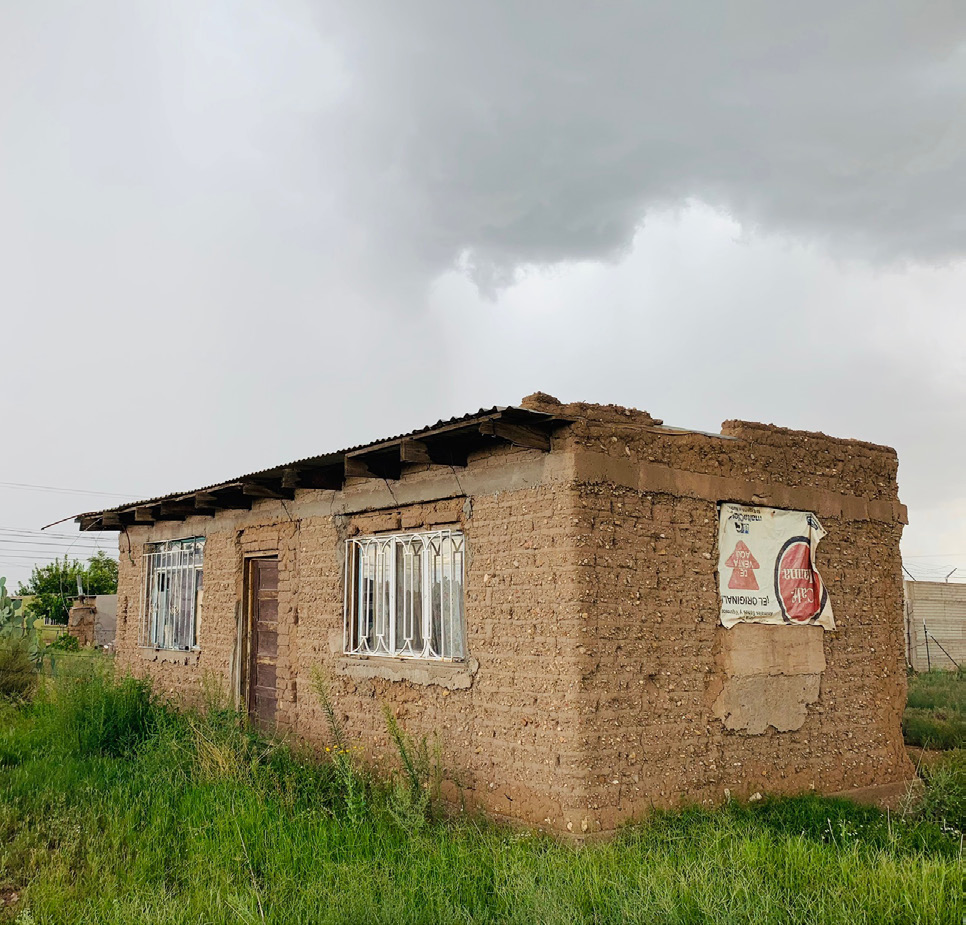 De La Cruz’s childhood home.
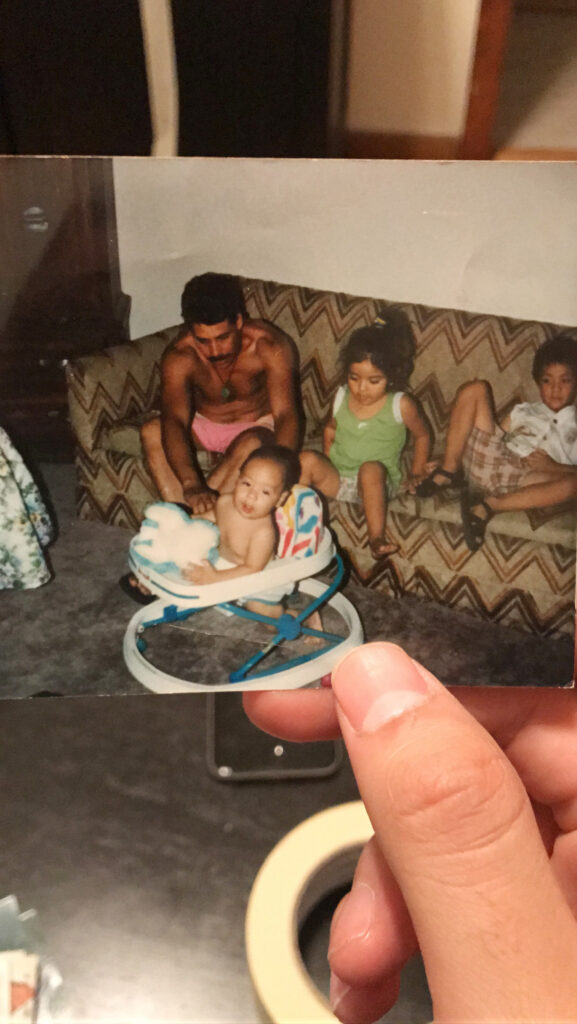 Luis, as a baby.
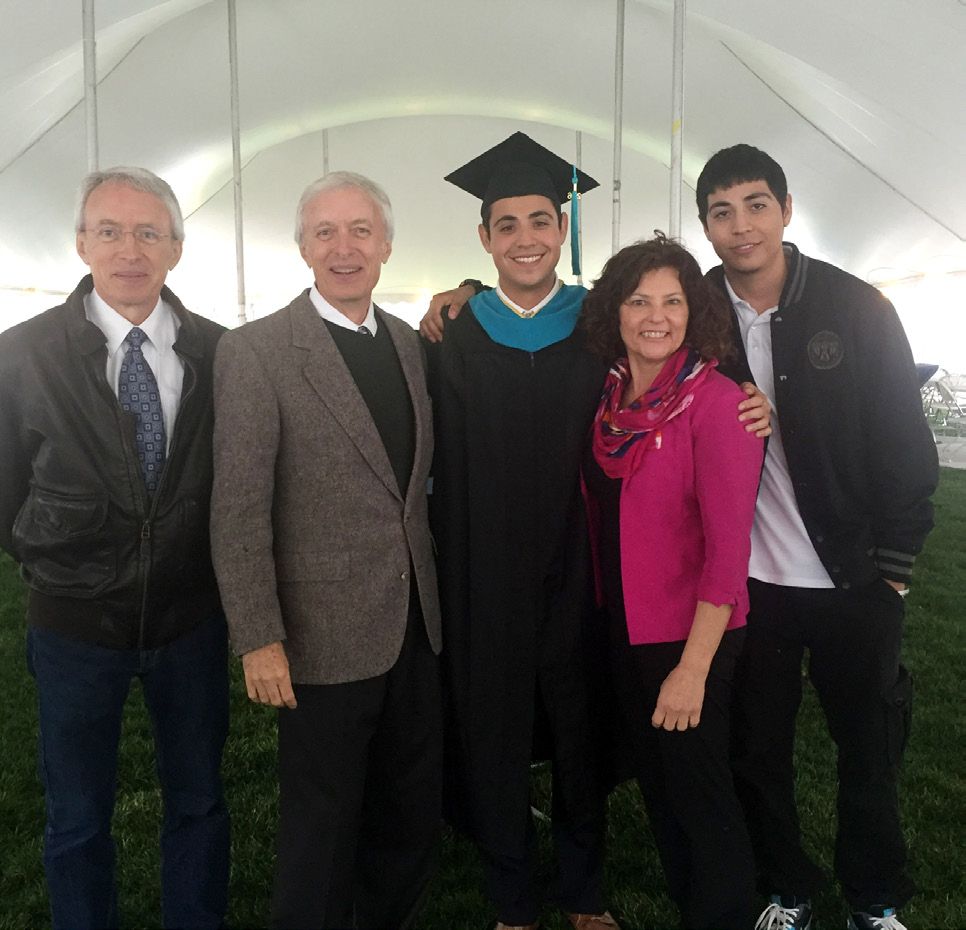 Luis’s graduation, with his foster family and brother.
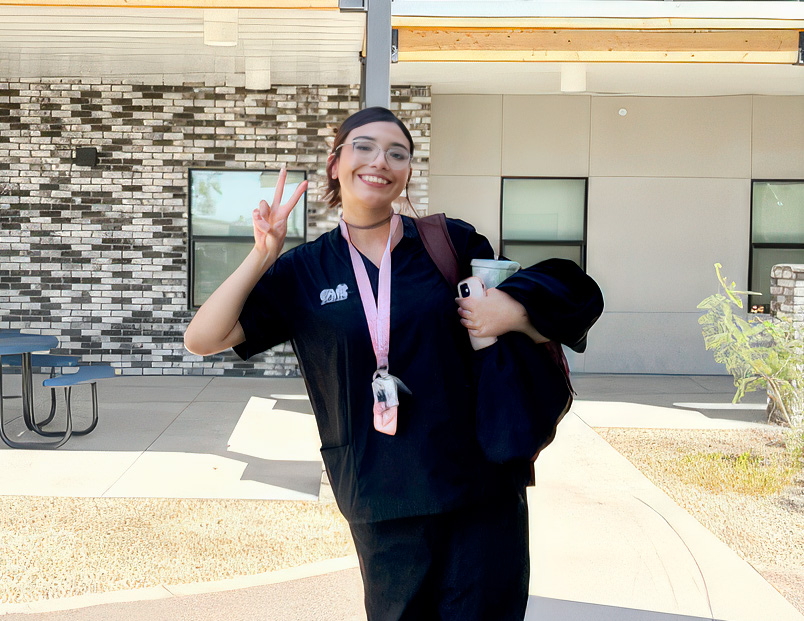
 At this year’s Backpack Buddies clothing distribution at Phoenix College.
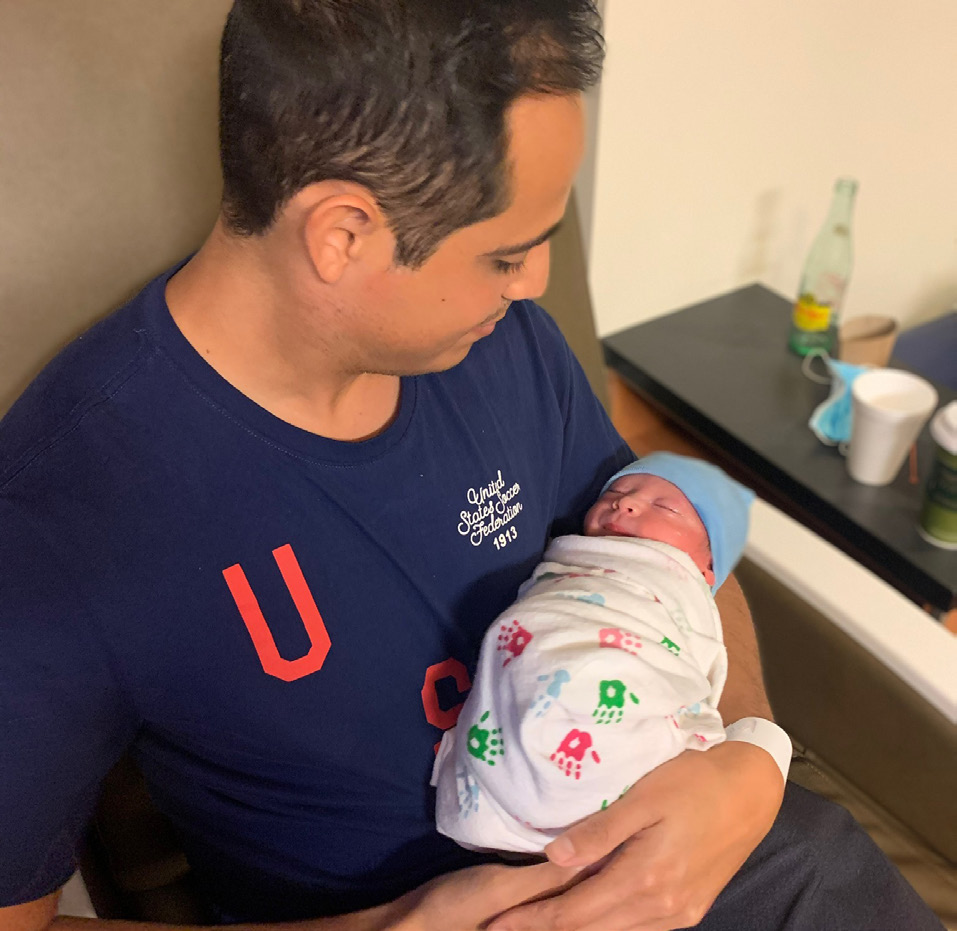 Embracing a new direction.
 Sharing AFFCF’s mission.



It is the story of three brothers.
After entering the system, Luis, the middle child, was placed with a family that was “highly educated” and “economically more than fine.” His younger brother was sent to a group home. His older brother, already 18, was left to fend for himself. Their divergence began almost immediately.
Foster care gave Luis something his childhood had not: stability. For him, education became an anchor. “It was my safe space,” he said. “It was where I felt safe. I was fed. I built friendships that uplifted me. I had teachers that showed kindness.” He became the first in his family to graduate high school, then earned two bachelor’s degrees from the Barrett Honors College at ASU, and a master’s in public policy from the University of Michigan.
His younger brother did not finish high school. Today, at nearly 30, he is often unhoused, often unemployed, contending with addiction and the same cycles of economic peril the entire family once shared. His older brother’s life is a similar struggle.
“Every day I see that and am reminded that somehow I’m the one that made it, and that is both empowering but also profoundly sad,” De La Cruz said, his gaze drifting toward a bookshelf lined with photos. In one, his foster mother is attending his graduation. His foster family was there for those big moments — his graduations, his wedding, there to pick him up from college when summer arrived and the dorms closed — a quiet, constant presence that helped fill a gap he hadn’t known could be filled.
“I understood very perfectly that I’m not special. I was just supported,” he said. “That’s it. I fundamentally believe that if my brother had been equally supported, his narrative today would be different. That is what drives a lot of the work that I do.”
Before he returned to the world that shaped him, De La Cruz first had to conquer another. He was a transfer pricing economist at Deloitte, the global consulting behemoth. He was also a fellow at Meta in Silicon Valley, living the tech-shuttle, catered-campus dream. He saw how power worked, “the way that business and government dance together, or not,” he said. De La Cruz was successful and comfortable — living proof of the American Dream. But a quiet question persisted: Now what?
The answer arrived with the birth of his first son, Mateo, at the height of the pandemic. Isolated in Chicago, with no family nearby, the world felt fragile. He and his wife, Nataly, whom he met at ASU, decided to move back to Arizona, a return to her family and to his foster “village.” The pull was twofold: a need for community and a reckoning with his past.
“When I talked to my wife about leaving that to come do this,” he said, “her response was very clear. She said, ‘You can do whatever you want to do, but just remember that you have a child now, and when he asks what you do for a living and why, you better have a damn good answer.’”
Today, he has his answer. At AFFCF, which serves nearly 4,000 children across the state every year, De La Cruz is creating solutions born from his own wounds. He is building what he wishes his younger brother had — a safety net that stretches beyond food and shelter into possibility and hope.
The organization’s Keys to Success program aims not for Ivy League prestige, but for the essentials of self-sufficiency. “You need a baseline education,” he said. “You’ve got to be able to get and keep a job, and you’ve got to stay housed.” From there, dreams of being a doctor or a hairstylist or simply experiencing stability can take root.
AFFCF’s scholarship program doesn’t just write checks for tuition. Recognizing that for foster youth, “the cost of a mistake is beyond quantity,” they created the Focus-Forward Fund. It is emergency funding for when a car breaks down or a utility bill comes due — the minor crises that can derail a life when there’s no one to call for a hand. “It works,” De La Cruz said, pointing out that the national college graduation rate for former foster youth is a dismal 3 percent. However, for youth in AFFCF’s program, the rate is nearly 70 percent.
But De La Cruz refuses to measure success only in numbers. He talks instead about moments of joy — a backpack filled with new supplies, a scholarship check that keeps a student in school, a foster parent waiting at the curb when summer starts so that a child doesn’t have to face homelessness again.
Under his leadership, the organization has nearly doubled the number of young people it serves. This is work that requires the entire community to engage, from the volunteers at a recent backpack drive to the major philanthropic partners that provide the fuel. He points to funders like BHHS Legacy Foundation as vital. “As a private foundation, without those dollars, we can’t do this work,” he said. “It enables us to do what we have got to do in the best way that we can, without having to navigate the challenges of strings being attached.”
An example was the Backpack Buddies event AFFCF and BHHS Legacy Foundation held at Phoenix College last summer. There, hundreds of children received new backpacks, shoes, clothes and supplies to start the new school year. The location was no coincidence. Dr. Kimberly Britt, the president of Phoenix College, sits on AFFCF’s board and is an alum of the foster care system herself.
“It’s humbling to have the opportunity to do something for the kids that we once were,” De La Cruz said. “One day, a child is going to say it was these events that allowed them to have the materials and school supplies and uniforms that they needed to show up to school and not feel embarrassed. That’s powerful.”
But the need extends beyond school supplies. There are currently about 8,500 children in Arizona’s foster care system, most under the age of 10. And there are only about 3,000 licensed foster homes available to care for them. The math is clear. Research shows that children placed with foster families are less likely to experience re-abuse and more likely to have the stability of fewer placements.
“We all play a role in supporting these kids, whether it be through dollars, but also when you think about what being a foster parent can do to change the narrative of a child’s life,” De La Cruz said. “Today, there’s only one home for every four kids. Our community can step up, and they can do more than write a check. It’s going to have lifetime implications for somebody.”
He speaks from experience when he says the goal must be to ensure families are waiting for kids, not the other way around. “The single best thing that anybody can do for children is give them a family-like setting,” he said. “Kids belong with people, not in institutions.”
To those considering it, De La Cruz offers both encouragement and realism. “I tell them, ‘Go do it. But also recognize that it’s hard.’ It is joy and hardship, bringing a kid into your home that is not your child,” he said. “It is hard to raise your hand and say, ‘I want to do this.’ But I think it’s probably one of the most meaningful things anybody can do. What else are we here for if it’s not to help change somebody else’s life?”
With two sons now, ages 5 and 2, De La Cruz finds himself in an unexpected chapter: shaping young lives while reparenting himself. At home, Mateo and Sebastian are tugging him into new territory: Disney movies, pool parties, movie nights with popcorn and ice cream.
“We’re going to Disneyland and experiencing that through them, but also for myself,” he said. “As a parent, I’m so imperfect, mostly because I didn’t have a role model. I don’t know what I’m doing half of the time.” He credits Nataly, whose “most beautiful childhood” serves as a guide. “Just because I didn’t get to doesn’t mean they shouldn’t. In fact, they should. So I have to work extra hard to make sure that they do.”
It is the daily act of closing a circle. The work is relentless, the need immense. So he propels himself — daily, tirelessly — toward a vision where Arizona becomes the gold standard for how to serve children in foster care. Toward a world where no child’s life is determined by the absence of support.
“I show up to work every day, I give it all I’ve got, and then I realize that it isn’t enough, and I do it again the next day,” he said. It is the promise of a man who knows the two roads, who carries the ghost of a one-room adobe and knowledge of much worse into every meeting, and who has dedicated his life to ensuring that for the next child, support is not a matter of fortune, but a matter of course.
To learn more, visit affcf.org.

Karen Werner is the editor of Frontdoors Media. She is a writer, editor and media consultant. She has interned at The New Yorker, worked at Parents Magazine, edited five books and founded several local magazines. Her work has appeared in Sunset, Mental Floss and the Saturday Evening Post.